aiSTROM: a roadmap for developing an AI strategy
Choose the right AI projects first. Then find out what each one really requires.
Version 2.0 · October 2026 · Dorien Herremans
RAND's 2024 report cites estimates that more than 80% of AI projects fail, and its interviews with 65 practitioners point to misunderstood goals, inadequate data, technology-first choices and missing infrastructure. RAND report.
aiSTROM, published in IEEE Access in 2021, is a strategic roadmap for avoiding those mistakes. An interdisciplinary team first lists possible AI projects and shortlists the top 3-5. Each shortlisted project is then analysed for data, AI team, positioning in the company, technologies, KPIs and risk level. The projects are compared on a risk-benefit plot and with a SWOT analysis, and the organisation chooses a balanced portfolio. Education and a culture of adoption complete the roadmap.
This toolkit turns the paper into fillable worksheets that follow its structure and terminology. Additions that reflect technology since 2021 (generative AI, agents) are marked as 2026 notes.
Start here: three PDFs, no installation
- aiSTROM worksheets: 10 fillable A3 pages.
- Completed example: AI for expense claims: a fictional company works through the whole roadmap.
- Instructor guide: a 90-minute session plan, facilitation prompts and four workshop exercises.
Save the PDFs and open them in a reader that supports forms. Print at A3 for workshops.
Who it is for: managers deciding where to invest in AI, lead developers and consultants scoping AI projects, and lecturers teaching AI strategy.
Run a session
- Gather a mixed team: people who know the business and people who know AI.
- Sheet 1 (15 min): list ideas, score impact and effort, shortlist three.
- Sheets 2-7 (30-45 min): split the team; each pair fills two sheets for all three projects.
- Sheet 9 (15 min): plot risk against benefit, run a SWOT and decide per project. Uncertain projects usually start with a prototype.
- Sheet 8: plan education and adoption before anything goes live.
You don't need to fill every box in one meeting. Revisit the sheets as prototypes and KPIs bring new evidence.
The sheets
| Sheet | Paper section | What you decide |
|---|---|---|
| How to use | The roadmap, the team, the starting situation. | |
| 1. Goals | III-A | Ideas from efficiency gaps, new technologies, competitors and new business models; impact vs effort; the top n projects (A, B, C). |
| 2. Data | III-B | Data sources, collection vs acquisition, data characteristics, privacy and security law, storage. |
| 3. AI team | III-C | Skills, domain knowledge, up-skilling, hiring or acquihiring, retention. |
| 4. AI in the company | III-D | Centralised, decentralised or hub-and-spoke; portfolio; AI as a service; in-house or outsourced; agility and prototypes. |
| 5. Technologies | III-E | State of the art and hybrid approaches; accuracy vs black box; human in the loop; replacing vs augmenting; cloud vs in-house hosting. |
| 6. KPIs | III-F | Value-based KPIs, hidden value, model performance metrics, AI-based metrics, reporting. |
| 7. Risk level | III-G | Stochastic nature, biases and ethics, security, other strategic risks, benefits. |
| 8. Cultural shift | III-H | Education, AI literacy, from fear to empowerment, centre of excellence, continuous education. |
| 9. Decide | III-G.3 | Risk-benefit plot, SWOT per project, decision per project and the portfolio. |
Sheets 2-9 have one column per shortlisted project, so the differences between projects are visible side by side. Each column ends with a conclusion that feeds into sheet 9.
See the example
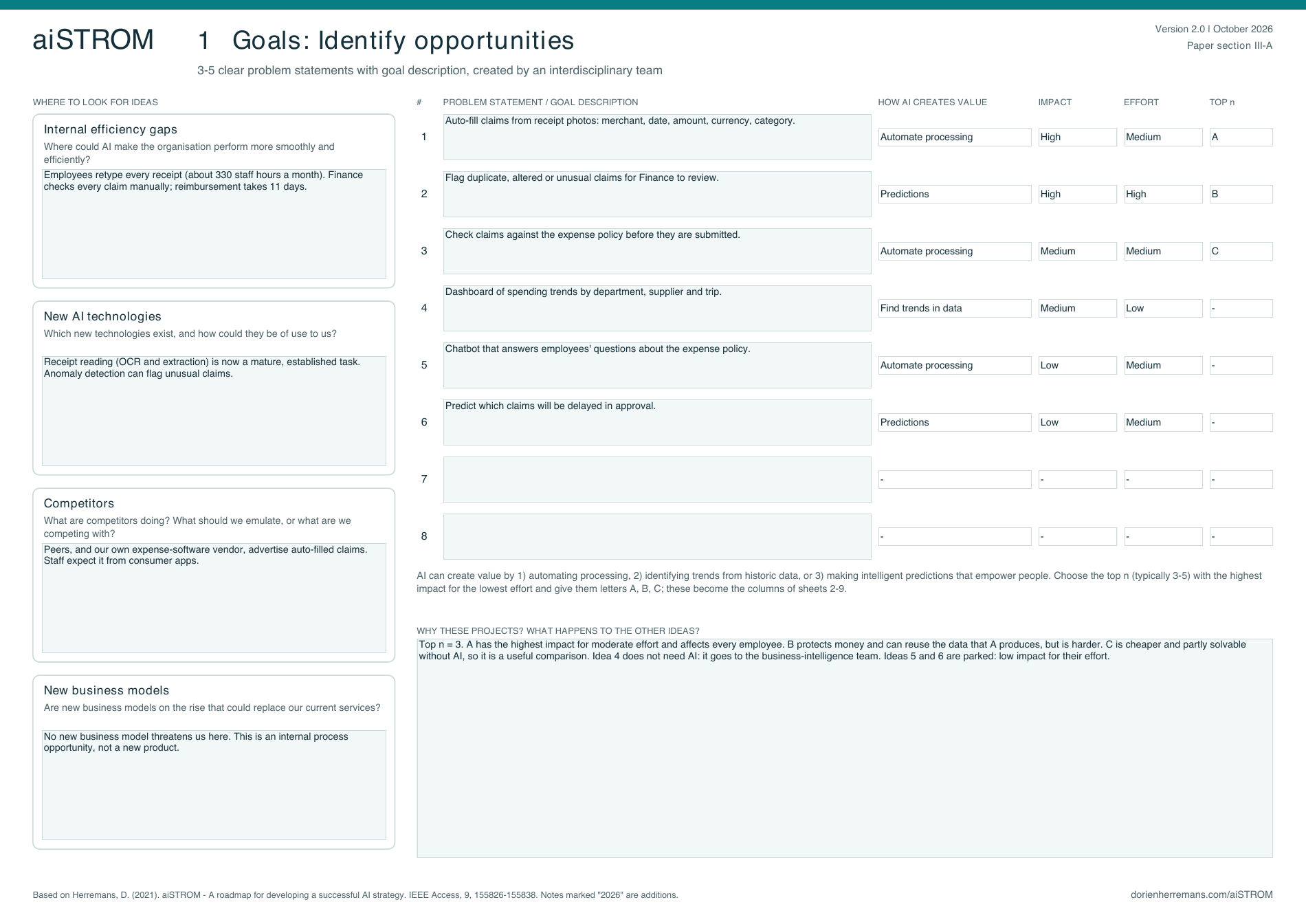
A fictional 1,200-person company asks whether to use AI in its expense-claims process. It lists six ideas and shortlists three: receipt auto-fill, fraud and duplicate flags, and a policy pre-check.
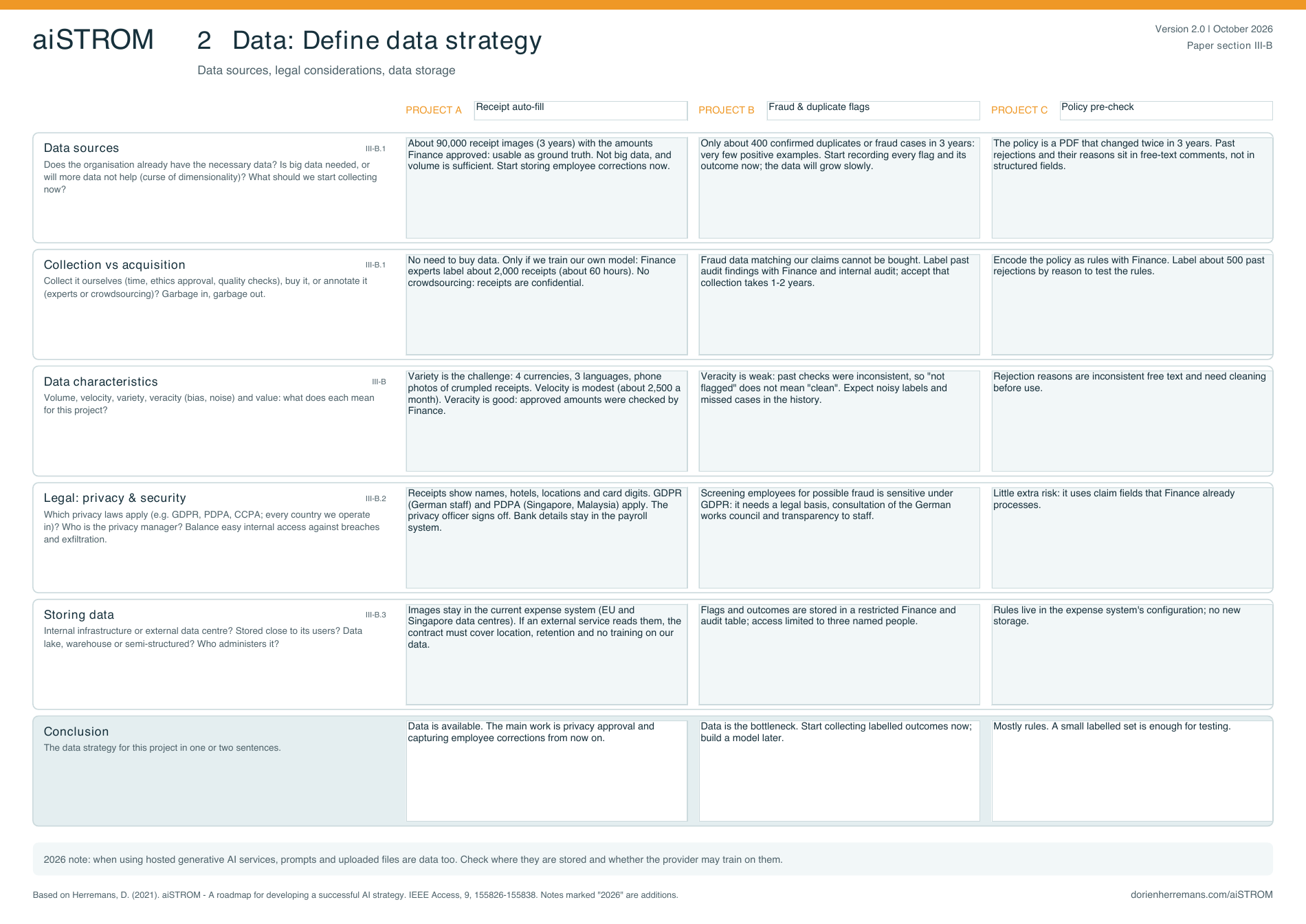
The same questions give very different answers: years of receipts with approved amounts for auto-fill, but only a few hundred confirmed fraud cases.
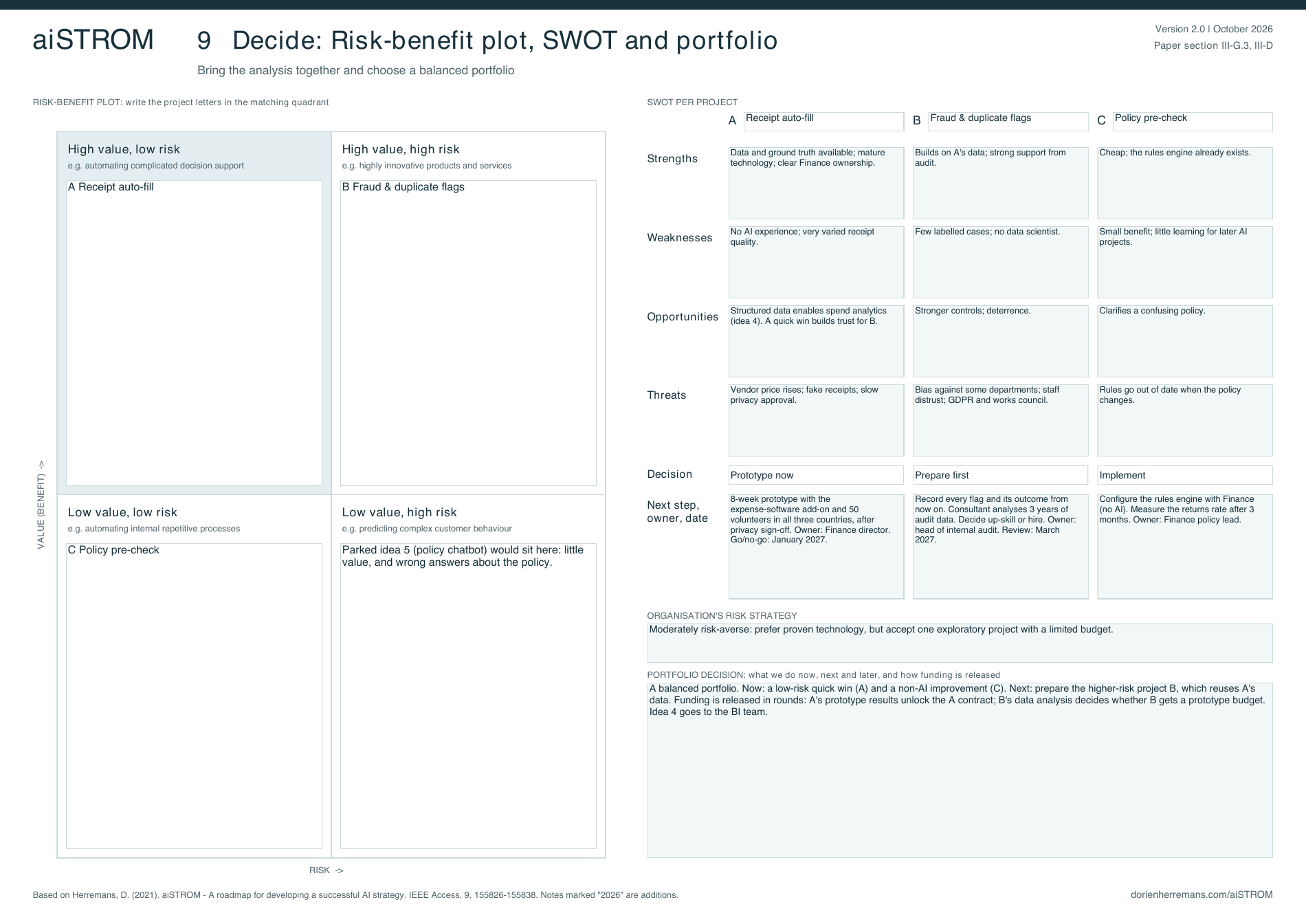
The outcome is a portfolio: prototype the low-risk, high-value project now, prepare the riskier one by collecting data, and solve the third with rules instead of AI. All figures in the example are illustrative.
The framework
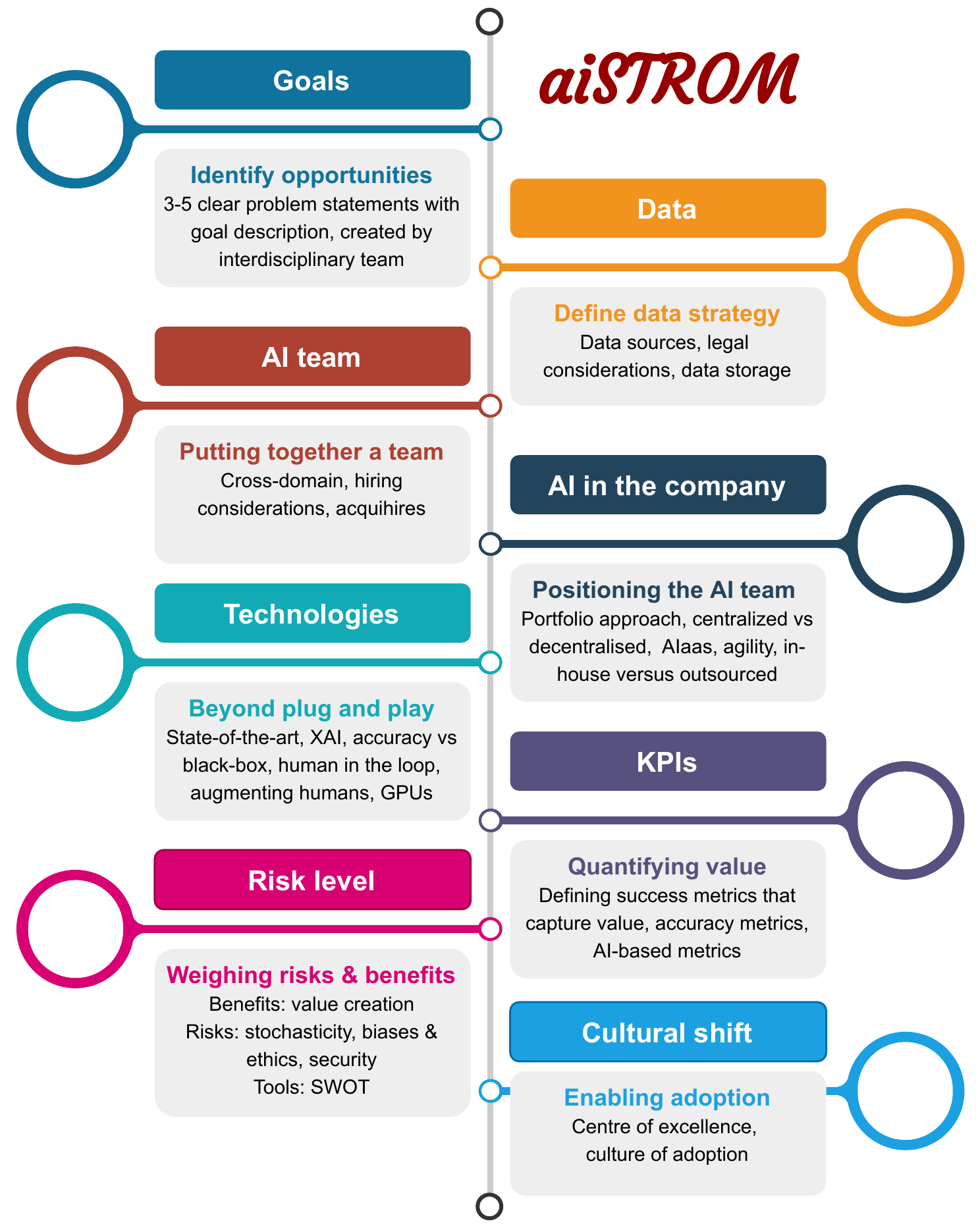
Original aiSTROM roadmap, Herremans (2021), Figure 1, reproduced from the open author version under CC BY 4.0.
Reference
Herremans, D. (2021). aiSTROM - A Roadmap for Developing a Successful AI Strategy. IEEE Access, 9, 155826-155838. Published paper · Open author version.
Cite
@article{herremans2021aistrom,
  author  = {Herremans, Dorien},
  title   = {aiSTROM--A Roadmap for Developing a Successful AI Strategy},
  journal = {IEEE Access},
  volume  = {9},
  pages   = {155826--155838},
  year    = {2021},
  doi     = {10.1109/ACCESS.2021.3127548}
}
Reuse
Toolkit materials use the repository's MIT licence. The original roadmap image is separately attributed under CC BY 4.0; see asset credits.